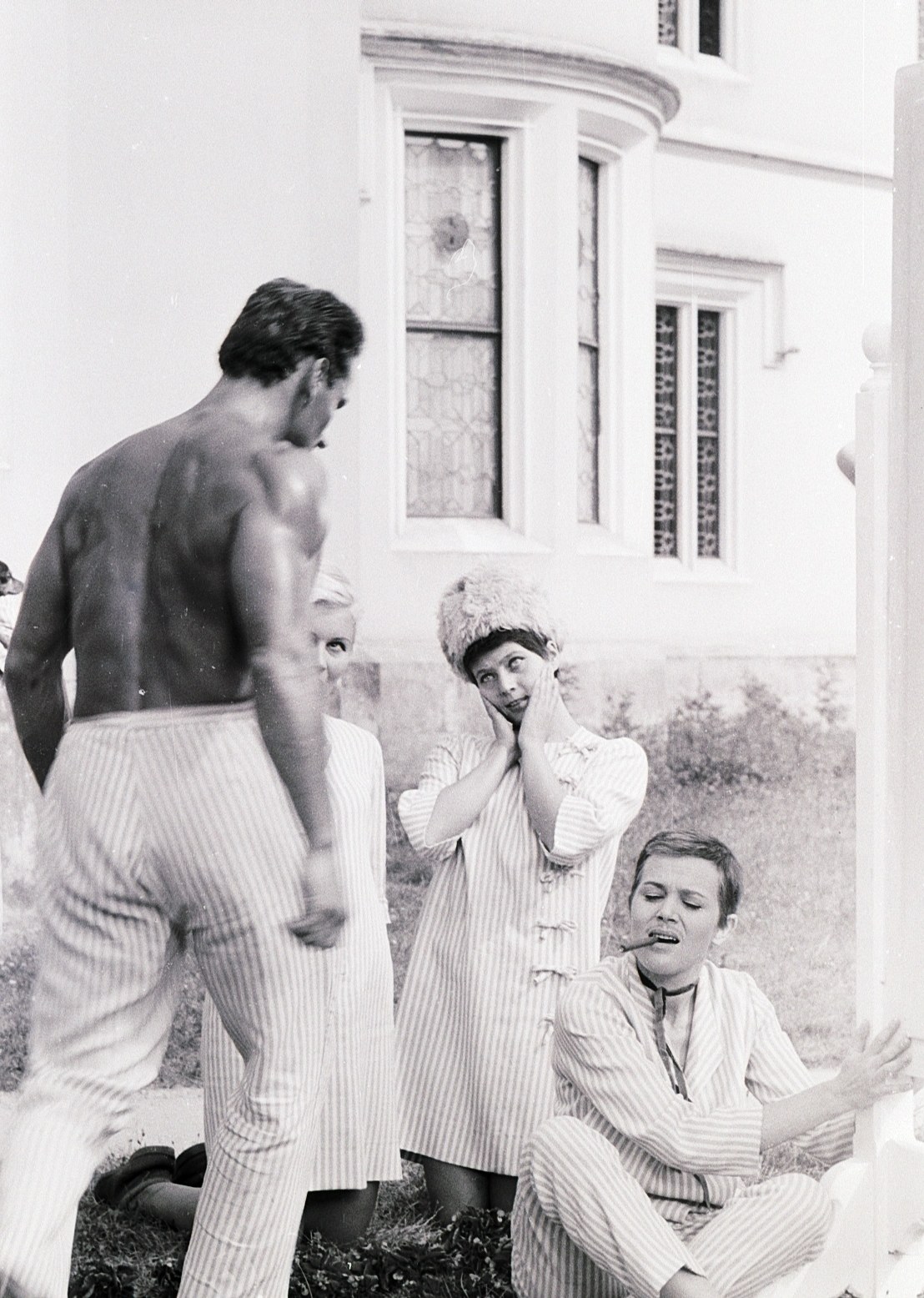
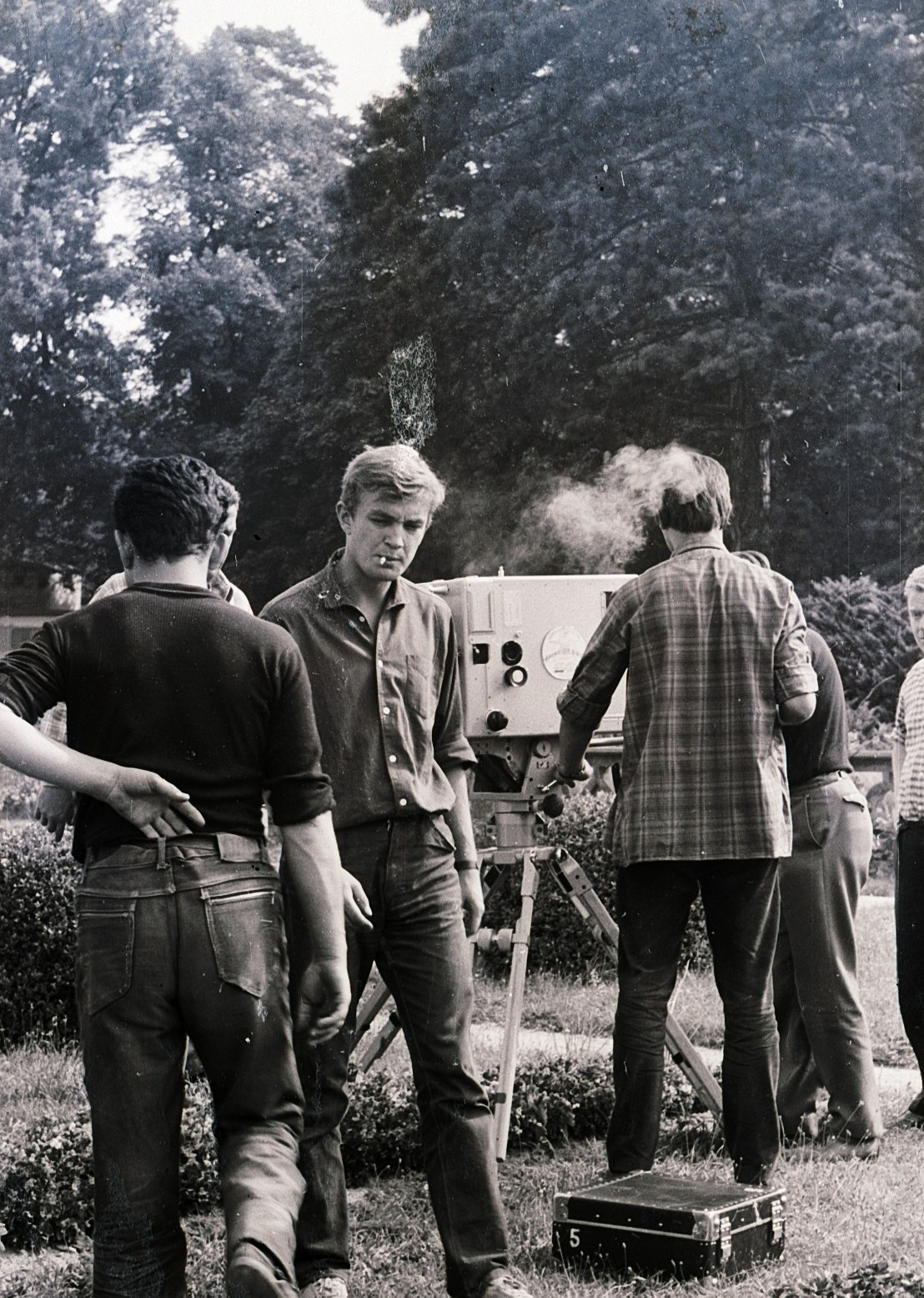
A man in striped trousers stands on a lawn with his back to us. Two women sit on the grass below him, also in stripes. Behind them, pale stone and tall windows. In other frames from the same afternoon there is a tripod, a camera with a heavy boxed body, and three men in plaid shirts standing around it having an argument.
Somebody was making a movie. That was the whole of what we knew.
The negatives came off a flea market in Prague. Twenty-five frames of this, all plainly from one afternoon — and they are not a roll. They run from the sixth strip to the end of one thirty-seven-frame roll, and pick straight up at the first strip of the next. Whoever was there shot the set continuously, through a reload.
What is on either side of those twenty-five is a separate problem, and we will come back to it.
We posted it to r/FoundPhotos in February. Three hundred upvotes, sixteen comments, thirty-eight thousand views, no answer. Google Lens returned nothing. Yandex returned nothing. Asked directly, a language model produced eleven paragraphs of analysis in which every specific claim was false.
It sat for five months.
What we had
Black-and-white 35mm, unattributed, secondary market, Prague. A film production in progress. That is the complete list.
On this site, az placed the frames in the 1960s from haircuts and clothing across the whole set, and read it as Czechoslovak New Wave backstage. Both correct, and neither one searchable. "Czechoslovak film, 1960s" describes several hundred titles.
The wrong turns, which are the useful part
On Reddit, HugeGoose8952 named the tension that makes these frames hard: the camera looks like 1950s equipment, the clothes look late 1960s. Not a contradiction — studios ran capital equipment for decades — but exactly the kind of split signal that sends a dating attempt sideways.
extension-128 got furthest on that thread by reading the striped garments as psychiatric ward uniforms and looking for a film set in an asylum. The candidate offered was Návrat ztraceného syna (1967). Wrong film, right instinct: the picture we were actually looking at does put its characters in an institution.
In July we reposted the set to a Russian message board. artimage recognised Václav Neckář, then spent several hours chasing him into the wrong production — the television series Píseň pro Rudolfa III — before turning up a still of the same striped shirt in a memorial gallery for the director Juraj Herz. Different production, and a dead end. But Herz's name was now on the table, and it stayed there.
Then Mikheev posted a full analysis he had got from Gemini Pro. It is worth listing what it asserted, because it is a clean specimen:
- Location: Zámek Hluboká nad Vltavou, identified from the carved lion on the balustrade, and stated to leave no room for hypotheses.
- Camera: a Debrie Super Parvo.
- Cast, by facial phenotype: Juraj Višný, and either Olga Schoberová or Jana Brejchová.
- Conclusion: a shelved film, or a sequence cut from a known comedy, perhaps Kdo chce zabít Jessii?
Wrong castle, wrong region, and none of those three performers is in the cast of the film this turned out to be. The reasoning about the lion was the right move and it is the only part worth keeping.
Note the phrase about leaving no room for hypotheses. That is the tell. When something hands you a geolocation and forecloses the alternatives in the same breath, that is the moment to ask what it would have said if it were wrong.
How it was solved
Strikeout took the one solid thread, Neckář, and did the unglamorous thing. Pulled his filmography for the period. Found that several of the films are sitting in full on Russian video hosts. Started scrubbing through them.
Twenty-one minutes and forty seconds into Kulhavý ďábel (1968), the scene matched.
He also pointed out something the rest of us had walked straight past: the man with the large moustache in one of our frames is the director. Herz played Asmodeus in his own picture, which puts him in front of the camera in the finished film and behind it on our negatives.
Asked afterwards how he had found it, his answer was one sentence about scrolling a filmography. There is no trick in it. That is the point.
The castle
Zadorno looked at the architecture and said, in effect: the building has been renovated, but that is the one, and the lion is still there. Hrádek u Nechanic, in the Hradec Králové region. 50°13'24.6"N 15°40'01.8"E.
Almost everything soft about the entrance has changed in sixty years. The façade has been repainted, an ornate iron gate now closes off the steps, and roses and clipped box have grown up on either side. Almost everything hard has not: the lion, the pedestal it sits on, the latch, the leaded lattice in the windows, the downpipe against the wall.
Not Hluboká. A different castle in a different half of the country, found by a person looking at a photograph.
oYASo put up a present-day photograph of the same doorway. When the identification was questioned, he went back to our frame and marked the matching features on it:
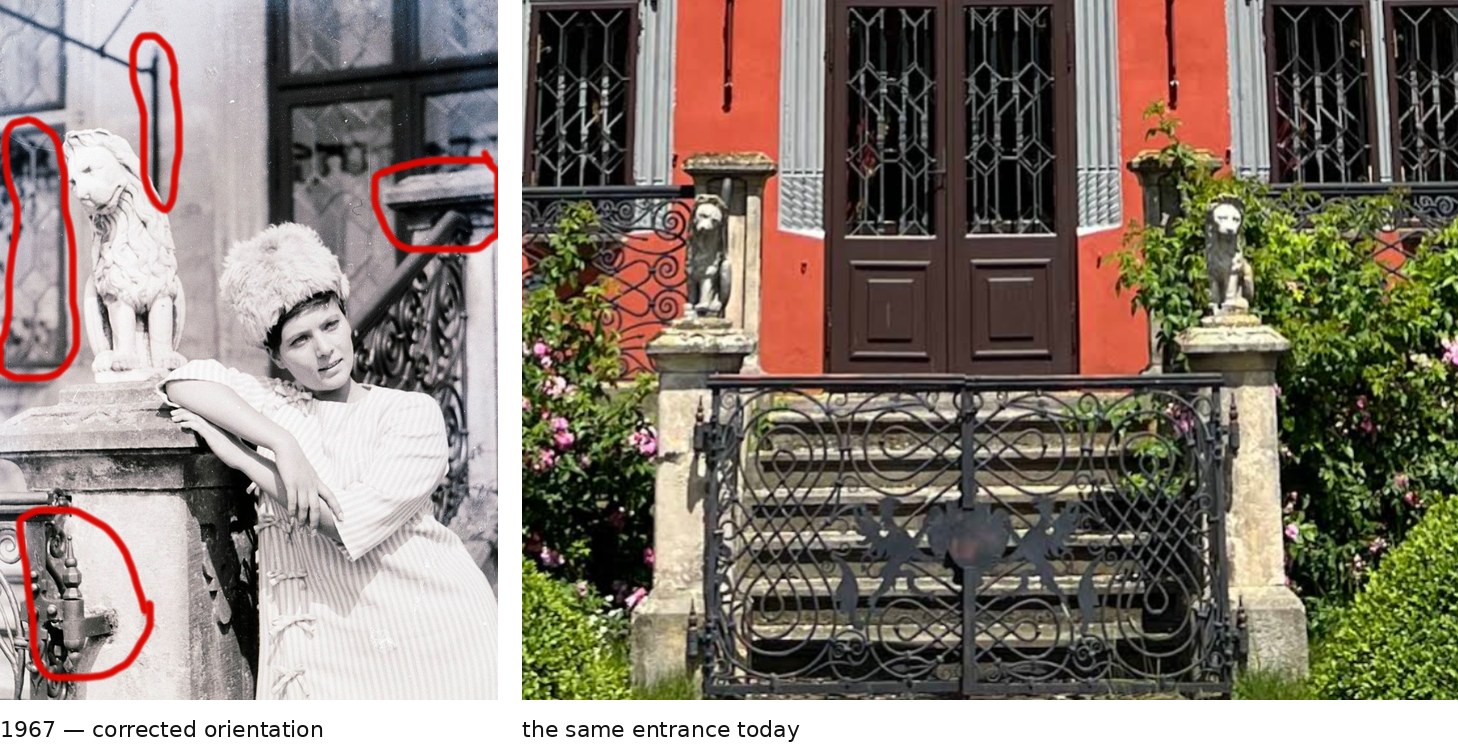
- The tilt of the lion's head.
- The gate latch and its mechanism.
- The newel post, and how the railing meets it.
- The diamond lattice on the windows and the doors.
- The pipework running up the wall.
Five features on one façade. That is a location call you can publish.
The line worth stealing from that exchange came while someone was still arguing for the first castle: wanting to be first to find the place is what produces wrong places. Which way is the lion's head turned?
The thing that had been in the way
Working through that comparison, Zadorno noticed something else. In our frame the woman stands outside the staircase, and in the geometry of the actual building she cannot. Either it is the other lion, or the photograph is mirrored.
artimage confirmed the second reading, and generalised it: a suitcase in another frame carries a painted digit running backwards, and an actor lying on a bench appears in the opposite orientation to the same shot in the finished film.
The whole set is mirrored.
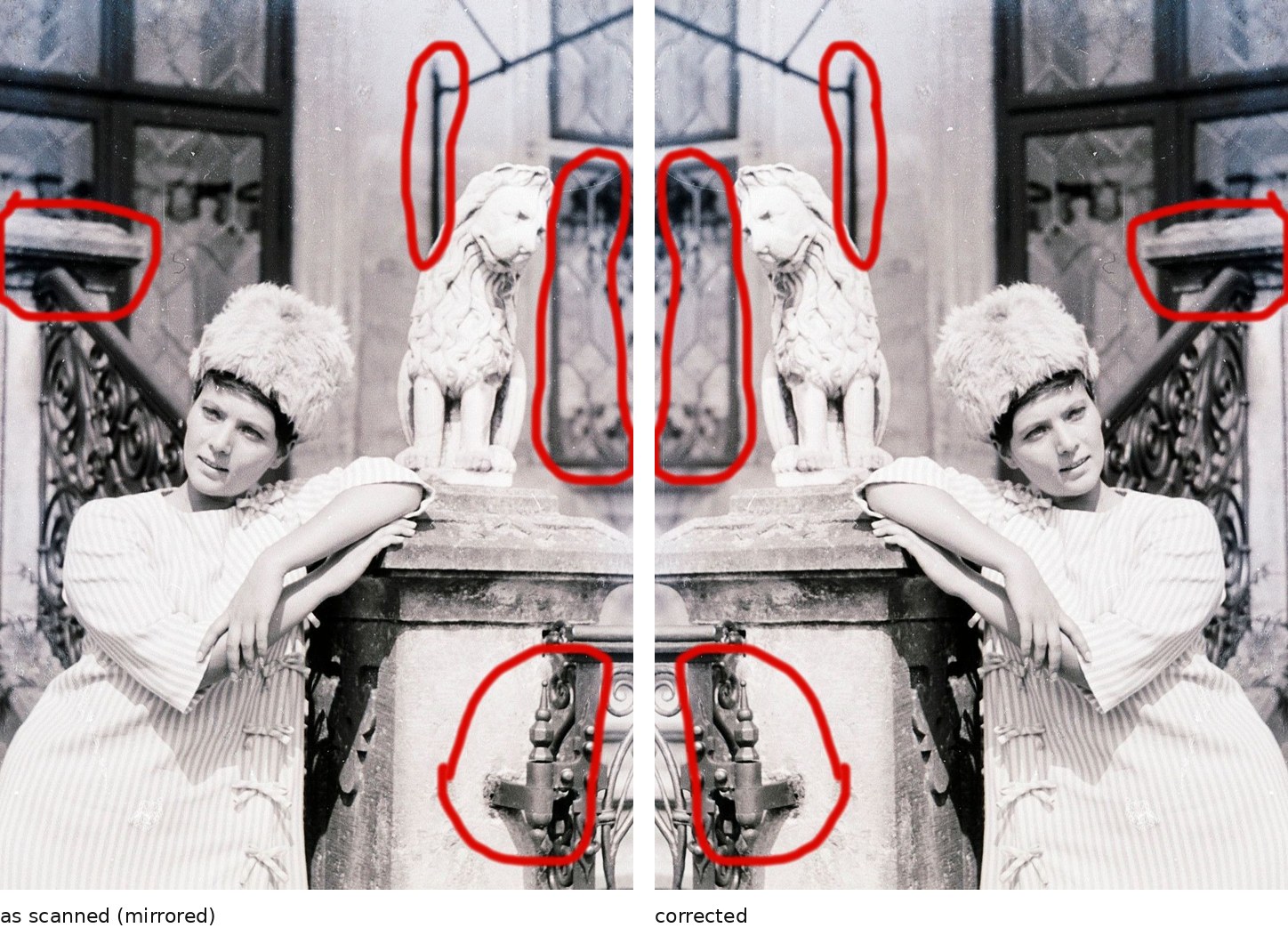
We did that. These were among the first negatives Old Findings ever digitised, and the film went into the holder emulsion-side up. Nobody noticed, because a mirrored photograph of a lawn still looks exactly like a lawn.
We now think it is most of the reason five months went by.
A person looking at a mirrored photograph of a castle sees a castle. Reverse image search does not. Perceptual hashes, embeddings and vision models encode feature geometry, and mirroring inverts it — a flipped frame is, to the index, a photograph of a building that does not exist. The subject was never obscure. Kulhavý ďábel has a Wikipedia article and a catalogue record at the Czech national film archive. The orientation was the obstacle.
Two things follow.
For us: a scan-orientation check now runs before anything is published, and the early batches are being re-checked — starting with the other fifty frames on these two rolls, which nobody has looked at since. This is what the real failure modes of mass digitisation look like. Not lost files, not colour drift, but a silent transform that survives every step downstream of it.
For anyone else working with found negatives: if reverse image search on an obviously identifiable subject returns nothing, flip the image and search again before concluding the subject is obscure. It costs one keystroke.
The answer
What. Behind-the-scenes frames from the shooting of Kulhavý ďábel (The Limping Devil), directed by Juraj Herz for Filmové studio Barrandov, very loosely after Alain-René Lesage's Le Diable boiteux of 1707. Photographed by Jan Novák, music by Jan Klusák. In the cast: Herz as Asmodeus, Václav Neckář, Jana Šulcová, Oľga Šalagová, František Zvarík, Václav Štekl. Released September 1968.
Where. Zámek Hrádek u Nechanic, Hradec Králové region. 50.2233 N, 15.6671 E. Confirmed twice over: the five-point façade match, and the production record, which names the castle. C4.
When. 1967. Shooting ran from 27 July 1967 to 18 January 1968. These are exteriors, on grass, in summer clothing, which places them in the first stretch of that schedule — late July to autumn 1967. C3.
This case carried the date 1968 until now. That was the release year, not the year the shutter opened. Corrected.
One thing worth knowing about the film. Per the archive's own record, it was cut about during the script stage and pulled from distribution in September 1976. It is not a picture anyone had reason to document. Which is roughly why an amateur set from its location shoot is worth this much of anybody's attention.
Contributors
- az — Czechoslovakia, 1960s, New Wave backstage (Old Findings)
- HugeGoose8952 — the camera-and-clothing split, New Wave framing (r/FoundPhotos)
- extension-128 — asylum setting, first candidate film (r/FoundPhotos)
- artimage — identified Václav Neckář; surfaced Juraj Herz; established that the whole set was mirrored
- Mikheev — pressed the castle identification hard enough to break it open
- Strikeout — identified the film, and the timecode
- Zadorno — identified Hrádek u Nechanic; first to see that the frame was reversed
- oYASo — the present-day comparison and the five-point verification
The July thread is here; the February one here. The film's record at the national film archive is here, and the production dates above come from Filmový přehled.
Still open
The case is answered. The rolls are not.
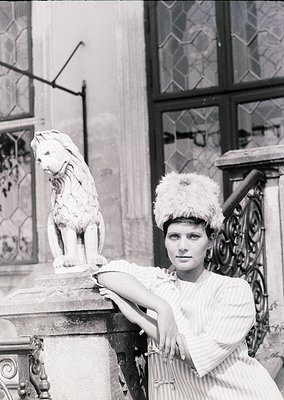
Who held the camera. Somebody stood inside a working set, unhurried, and shot for a full afternoon. Three frames of the crew at the camera. Three separate takes of the same woman at the same lion — and in all three she is posing, arm placed, gaze taken off camera. That is not a passer-by with a snapshot, and it is not press coverage either. Somebody the production knew well enough that an actress would hold a pose for them.
What is on the rest of the two rolls. This is the strongest thread we have and we have not pulled it. Before the film set, on the same roll: a Mediterranean port seen from a ferry, Greek ruins — the columns look like the Olympieion and the Acropolis — a street with a Russian-language shop sign, an airliner in Aeroflot markings, aerial views of snow and of salt pans, and a modern airport terminal with a Swissair aircraft on the apron. After the film set, on the next roll: winter forest, a stone causeway over marsh, buried concrete, a mountain village, a multi-arched viaduct over a wooded valley.
One person, one camera, one stretch of months. Somebody who in 1967 was photographing Athens and flying, and who could also stand on a Barrandov location shoot. That is not a large population. Every one of those frames is its own identifiable place, and each one narrows the photographer.
Which sequence. The film-set frames show a coffin on a trolley, orderlies in white, striped ward clothing, a reflector board, and a woman in a heavy fur hat in obvious summer. Does this material appear in the finished film, and where?
Everyone else. The man carrying a timber beam is crew, not cast. The woman at the lion, the woman with the cigar, the man on the lawn: all unidentified. We have the cast list and we are not going to guess from faces. If you can put a name to a frame from the film itself, that is a different matter.
The film-set selection is here; the two full rolls are F0000003 and F0000004.
Václav Neckář is living. These frames are published under the artistic and reportage licence of §89 of the Czech Civil Code: a professional performer at work on a film set, non-commercially. No promotional or commercial use. Takedown on request, same day.