The roll had no holidays on it. No beach, no wedding, no children in a sandbox. Someone had laid documents out on a table and photographed them, one page at a time, the way you do when there is no photocopier and you need a second copy of something that matters.
These films reached us through a private sale from Ukraine, not from the Czech material that makes up most of our collection. The documents are from Kyiv, and they belong to a man named Borys Kyrylovych Shenger, born in 1941.
Who he was
He had a Group I disability — the most severe category in the Soviet system, the one meaning permanent incapacity for work. He lived on the western edge of Kyiv. He wrote: stories, novellas, essays, published in the Kyiv press, and he was still carried on the books of the Writers' Union of Ukraine as a young author in his forties. He moved around the city on an electric wheelchair.
The file never names his condition. It is careful about some things and completely silent about others, and I am not going to invent a diagnosis for a man who never published one.
But the documents do describe, in passing, exactly which parts of him worked. His legs did not. Nor did his right arm — when the Writers' Union writes to the Minister of Health, it asks for a chair with left-hand-only control. An asymmetric paralysis that takes both legs and one arm and leaves the other arm intact is not what a spinal injury looks like: a broken back gives you a level, and everything below the level goes. Weakness distributed limb by limb, sparing one, is the signature of polio.
The timing fits too well to ignore. The Soviet Union's polio epidemic ran through the 1950s — the state stood up an entire research institute for it in 1955, and mass vaccination only arrived in 1960, when 77.5 million people were immunised in a single year. A boy born in 1941 spent his whole childhood inside that window and turned nineteen just as it closed.
None of this is proof, and it should be held loosely. It is a reading of what the paperwork lets slip. But it is the most probable explanation of a man who steers with his left hand.
The file does say one thing about where he came from, on a sheet dated four years before anything else in it.
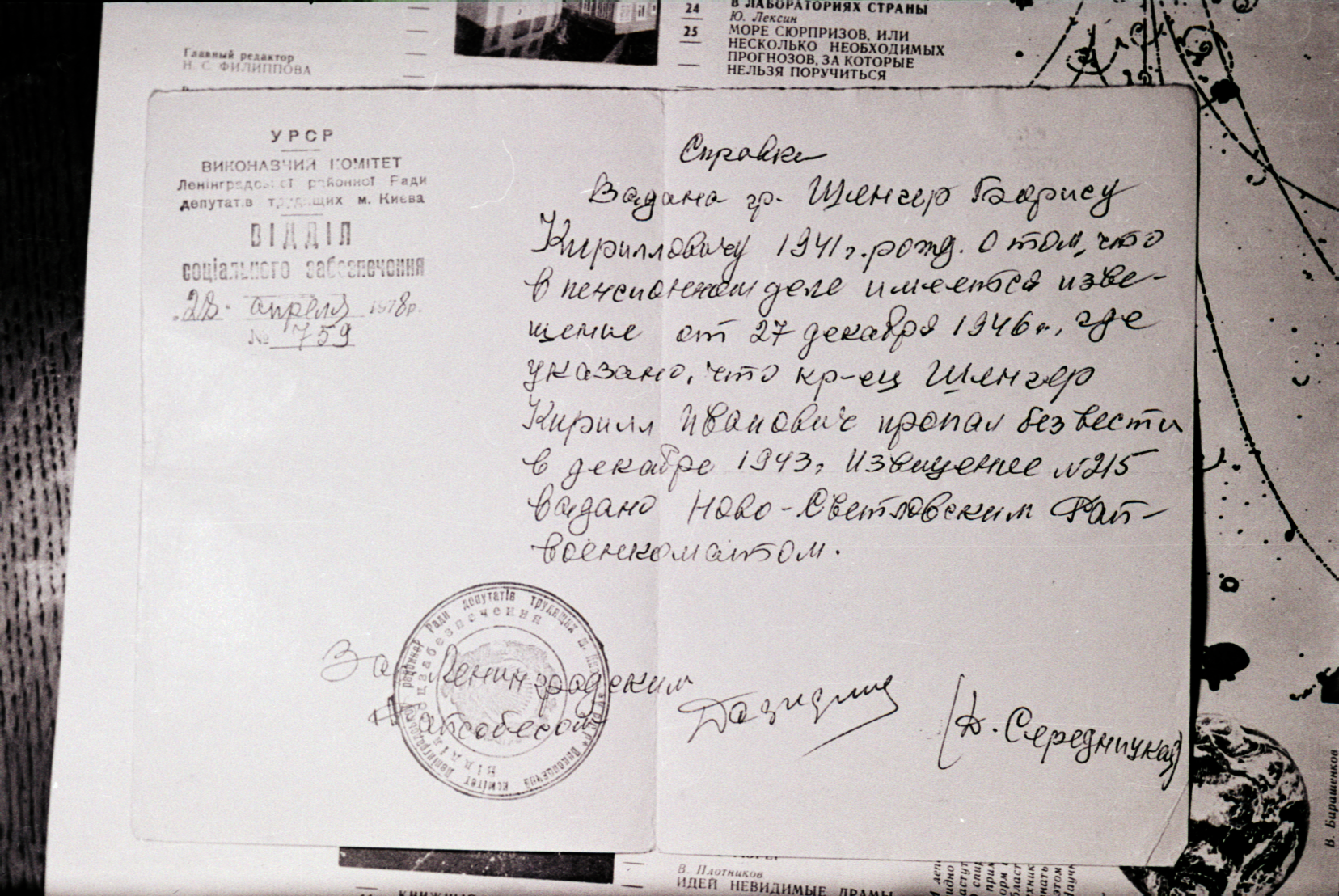
On 28 April 1978 the social security department of the Leningradskyi district of Kyiv issued him a certificate. It confirms that his pension file contains a notification, dated 27 December 1946, stating that Red Army soldier Kyrylo Ivanovych Shenger went missing in action in December 1943. Notification No. 215, issued by the Novosvitlivka district military commissariat.
So he was born in 1941 and his father disappeared when he was two. Novosvitlivka is not Kyiv — it is a district centre in the Luhansk region, six hundred kilometres east, occupied by German forces in July 1942 and retaken early in 1943. That is where the family was. The notification came three years after the fact, in the wave of post-war household surveys that formalised missing-in-action status so widows and children could be put on a pension.
Remember that sheet. Four years later the Soviet state is going to make him an offer, and the offer only makes sense next to this.
The machine
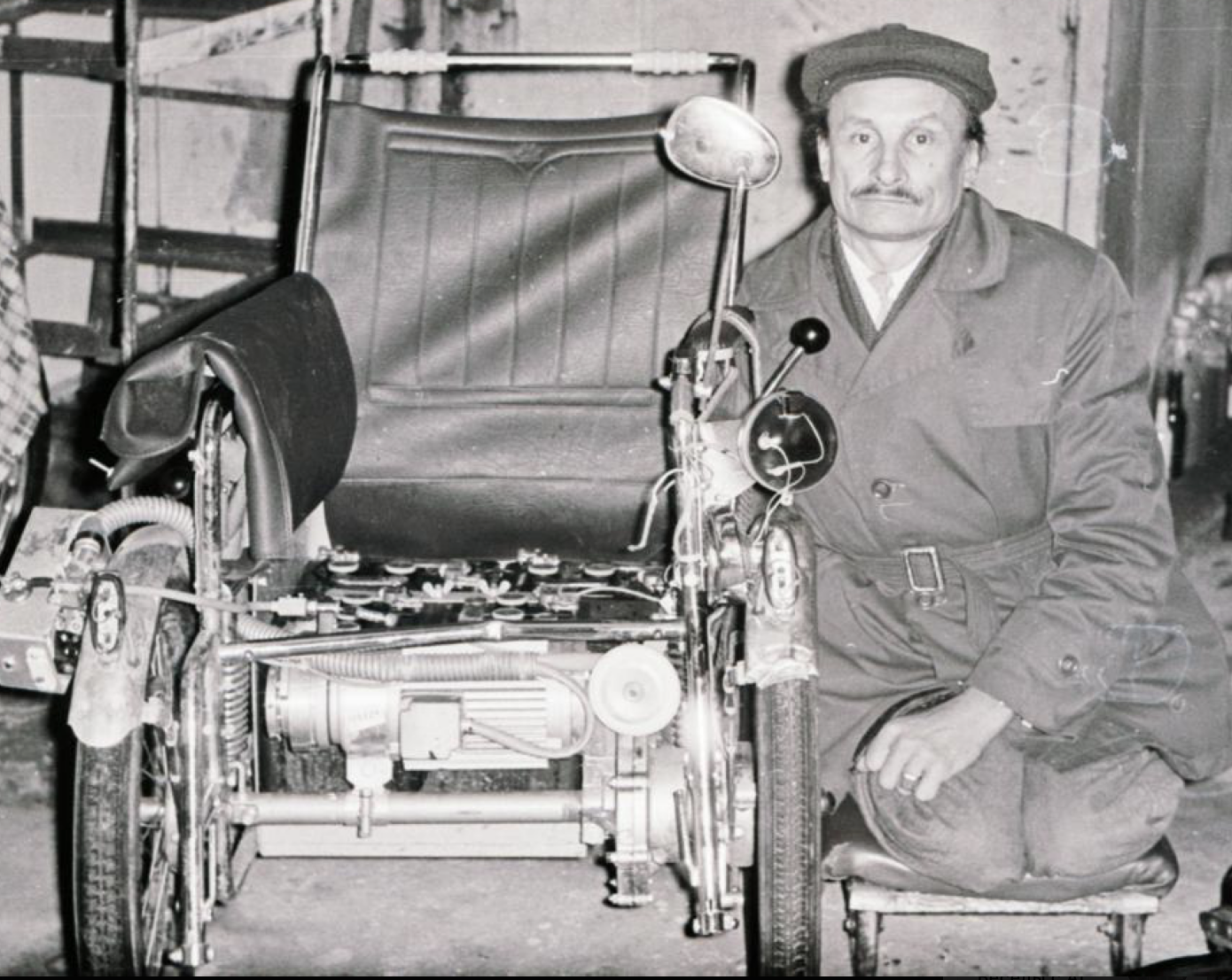
That is him, in a workshop, in a flat cap, kneeling on a low wheeled board with the chair stripped down beside him — fenders off, motor exposed under the seat, the whole bank of contactors open to the air. And this is him again, cleaned up, in a double-breasted checked jacket and a tie, with a badge on the lapel and the same machine reassembled around him.
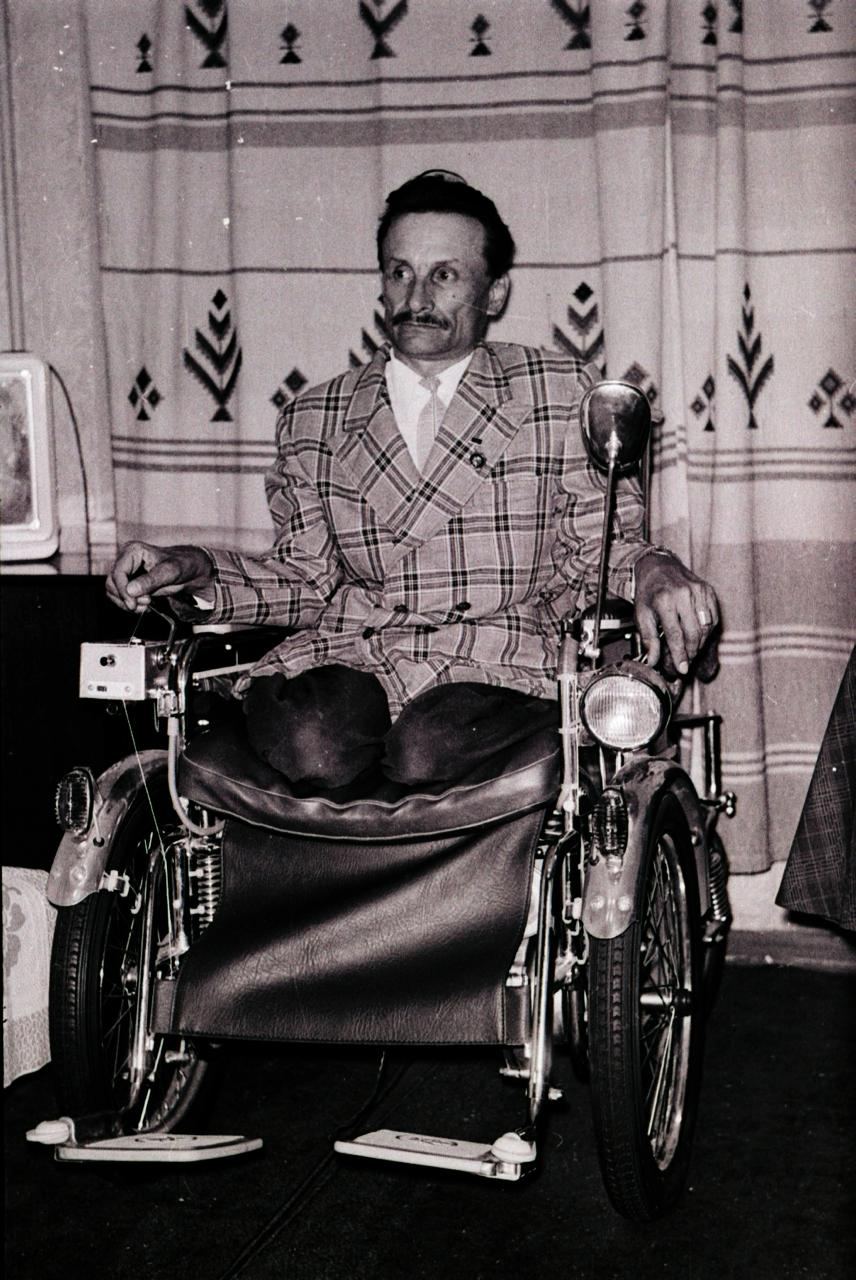
I got the second photograph badly wrong at first. I dated it to the 1950s on the strength of that jacket — wide lapels, broad tie, the whole silhouette. Clothing is a tempting clue because it is the biggest thing in the frame. What corrected me was the mirror: the same mirror, on the same curved stalk, is there in the workshop shot. Same fork, same suspension, same white box on the same bracket. One machine, one period, and both portraits standing thirty years later than I had put them. Hardware dates a photograph more reliably than fabric does. People wear old clothes. Machines are what they are.
The machine is a Meyra, model 35, made in West Germany. It was bought for him in 1980 with state hard currency — a foreign chair, for a private citizen, paid for in foreign money. To understand what that meant, you need to know what the alternative was.
The system he was inside
Soviet wheelchairs of the period weighed up to 37 kilograms. They did not fold, they did not fit in a lift, and a flight of stairs stopped them dead. Valery Fefyolov, who broke his back in 1966 and went on to edit an underground bulletin about disability in the USSR, described people building their own chairs out of kitchen furniture rather than use the issued ones.
The motorised alternative, the little SMZ motokolyaska, was issued for five years and, by the accounts of the people who had them, started falling apart within one, with spare parts unobtainable outside a special order and a months-long wait.
And the Zaporozhets? A free Zaporozhets with hand controls went to disabled veterans of the Second World War, on a seven-year term, after which the car went back to the state. Shenger was not a veteran. His father had gone to that war and not come back, which entitled the family to a survivor's pension and to nothing else whatsoever. The son had no claim on a car.
Which is exactly what makes the letter of 14 July 1982 worth reading twice.
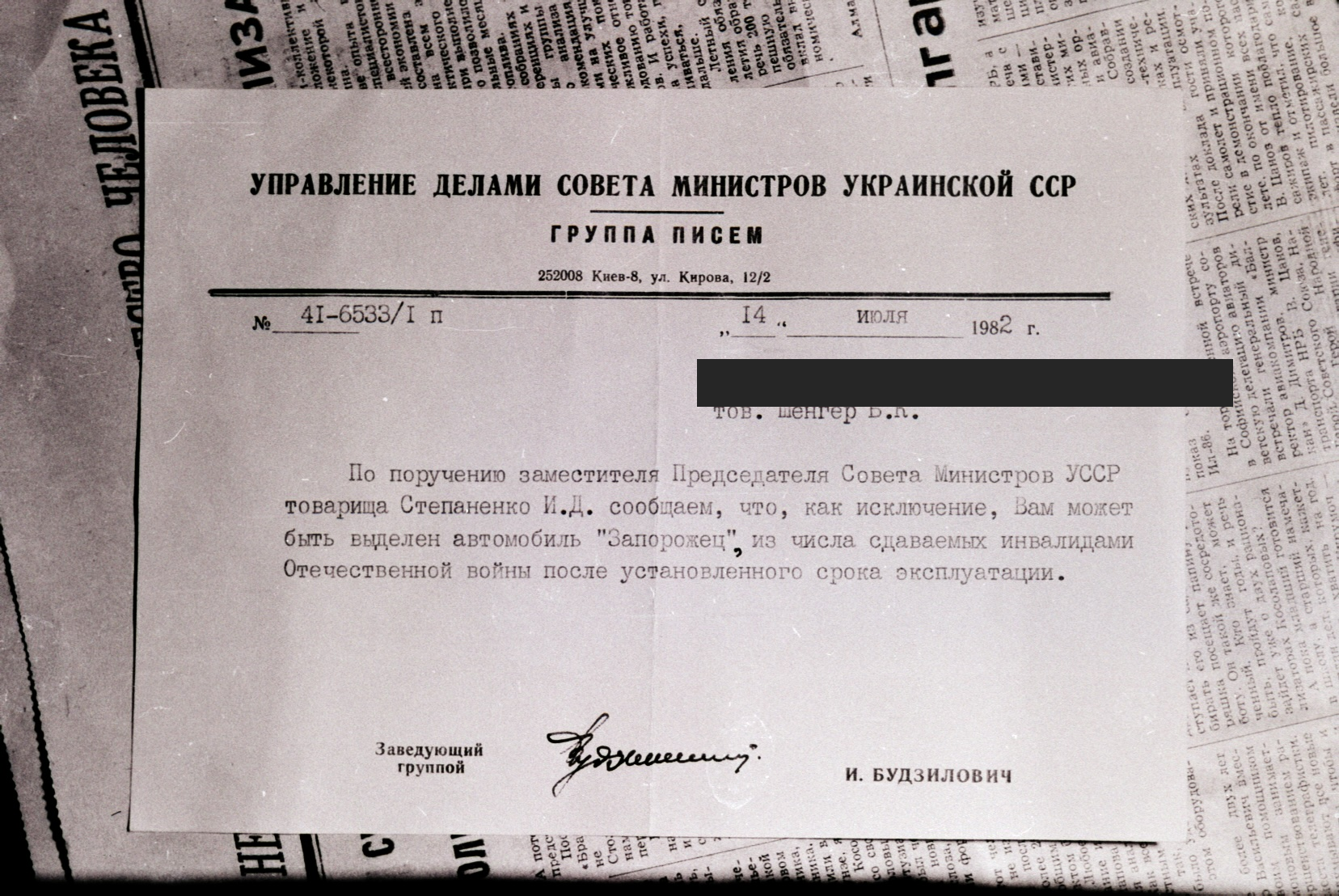
The Administrative Department of the Council of Ministers of the Ukrainian SSR informs him that he may, as an exception, be allocated a Zaporozhets — one of the cars being handed back by disabled war veterans at the end of their service life.
Read that again. The son of a soldier who never came home is offered a second-hand car from the queue of men who came home wounded. Not a wheelchair — a used car, in a country where he had no legal claim to any vehicle at all, extended to him as a personal favour.
That is not a grant. That is a refusal wearing a coat.
A month later, on 17 August 1982, the Red Cross Society of the Ukrainian SSR writes to the Ministry of Social Security on his behalf.
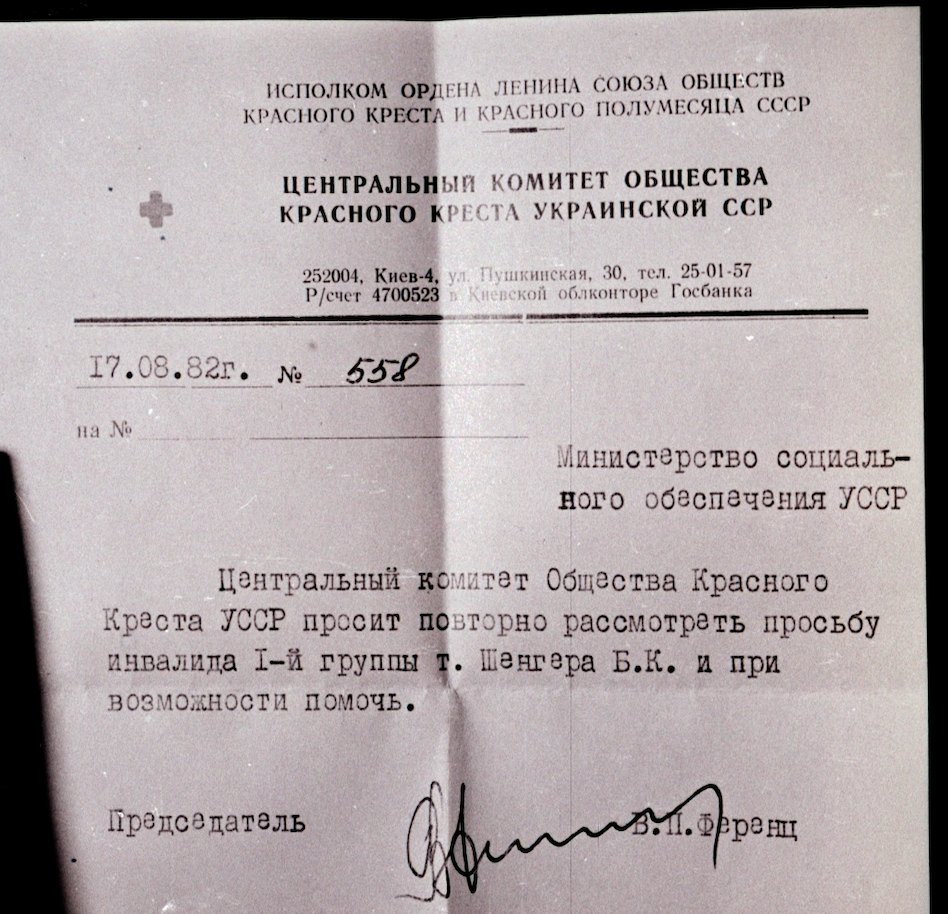
The Central Committee of the Red Cross Society of the Ukrainian SSR requests that the petition of Comrade B. K. Shenger, a disabled person of Group I, be reconsidered, and that assistance be provided if possible.
— Ref. No. 558, 17 August 1982, signed by the Chairman, V. P. Ferents. Translated from Russian.
Four lines, and one word does all the work. Reconsidered. You do not reconsider something that was never decided. By August 1982 he had asked and been turned down, and the refusal is not in this file.
The summer he was writing
It is worth knowing what else was going on in Kyiv while these letters went back and forth.
1982 was the city's 1500th birthday. The anniversary had been negotiated with UNESCO and then rewritten by Moscow into a safer story about three fraternal peoples, and at the end of May the city threw the first Day of Kyiv it had ever held. The Golden Gate reopened. The Museum of the History of Kyiv opened in the Klovsky Palace. Podil was tidied up and the rotunda on Kontraktova Square rebuilt from surviving drawings. There was a stadium show, a military brass band outside the park, a new monument to the founders of the city. Newspapers ran a standing column on the anniversary, and for the first time in decades there was a flood of published material about Kyiv's own history where there had been almost none.
The city was being made presentable at enormous expense. There were no ramps in any of it.
And that October an old hand-controlled Zaporozhets drove across Ukraine towards the western border. In it was Fefyolov, the bulletin editor, with his wife and her two children, leaving the country under threat of prosecution. The people who had spent four years documenting how Soviet disabled people actually lived were being pushed out through the same republic, in the same months, in which Shenger was writing his letters asking to be allowed to move.
Neither man knew about the other. That is rather the point.
30 December 1982
Three days before New Year, on Borshchahivska Street, a sanatorium minibus and the electric wheelchair collided. He was taken to hospital, where a wound above his left eye was stitched, and discharged a week later.
On 7 January 1983 the state traffic inspectorate of the Radianskyi district issued its decision.
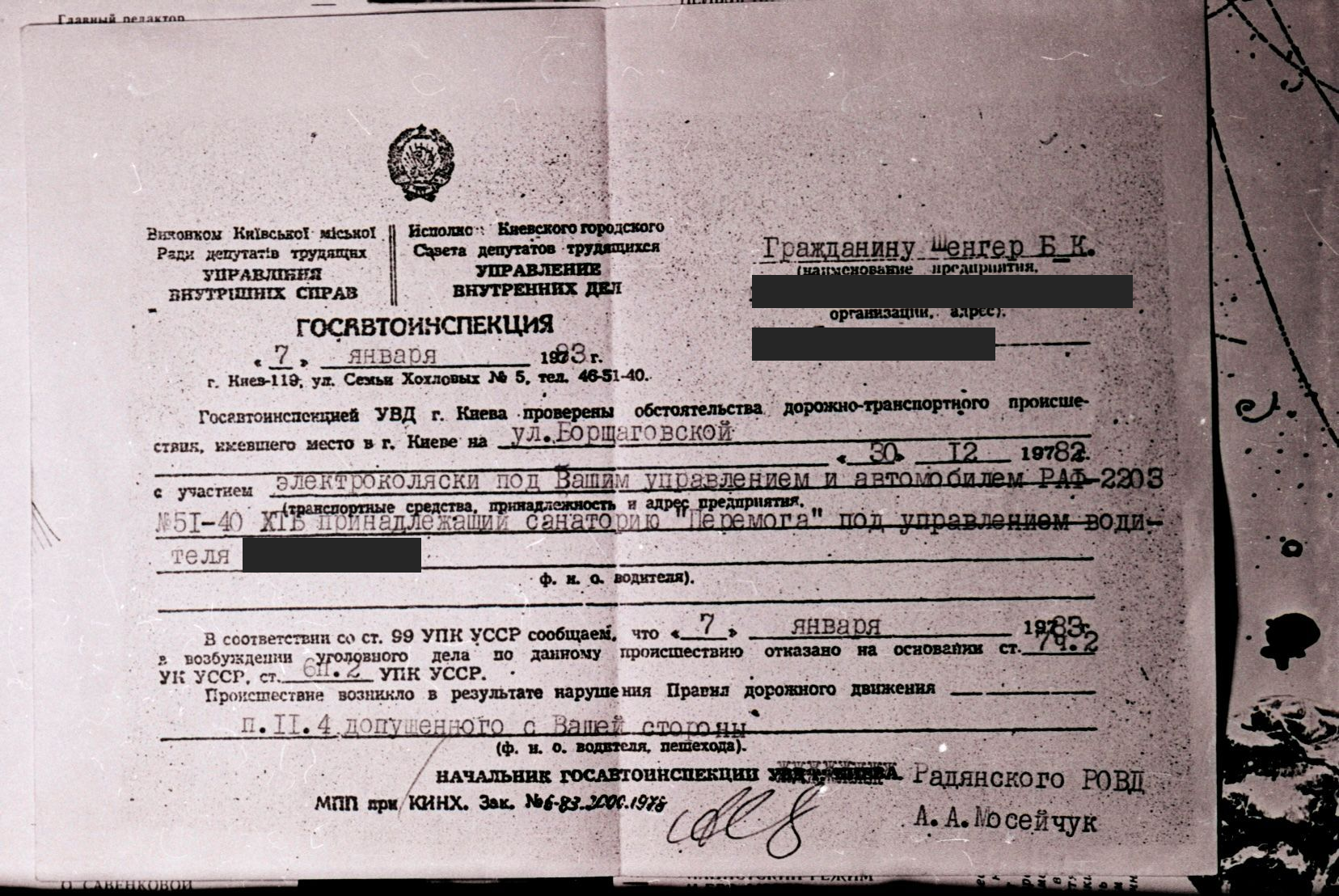
No criminal case. The cause of the accident was a breach of the traffic regulations committed by him — paragraph 11.4, improper lane change.
A man in a wheelchair changed lanes improperly in front of a minibus. That is the official account of what happened.
A medical certificate from the same file, written by the doctor who treated him, describes the event the other way round: the wheelchair was struck by a vehicle. Two official documents, one incident, the subject and object of the sentence swapped. Only one of them was used for anything.
Note also the phrase the traffic inspectorate reaches for in the middle of the form: the electric wheelchair under your control. Hold on to that.
As an exception
Twelve days after being told he was at fault, the Kyiv branch of the Writers' Union of Ukraine writes to the Minister of Health of the USSR.
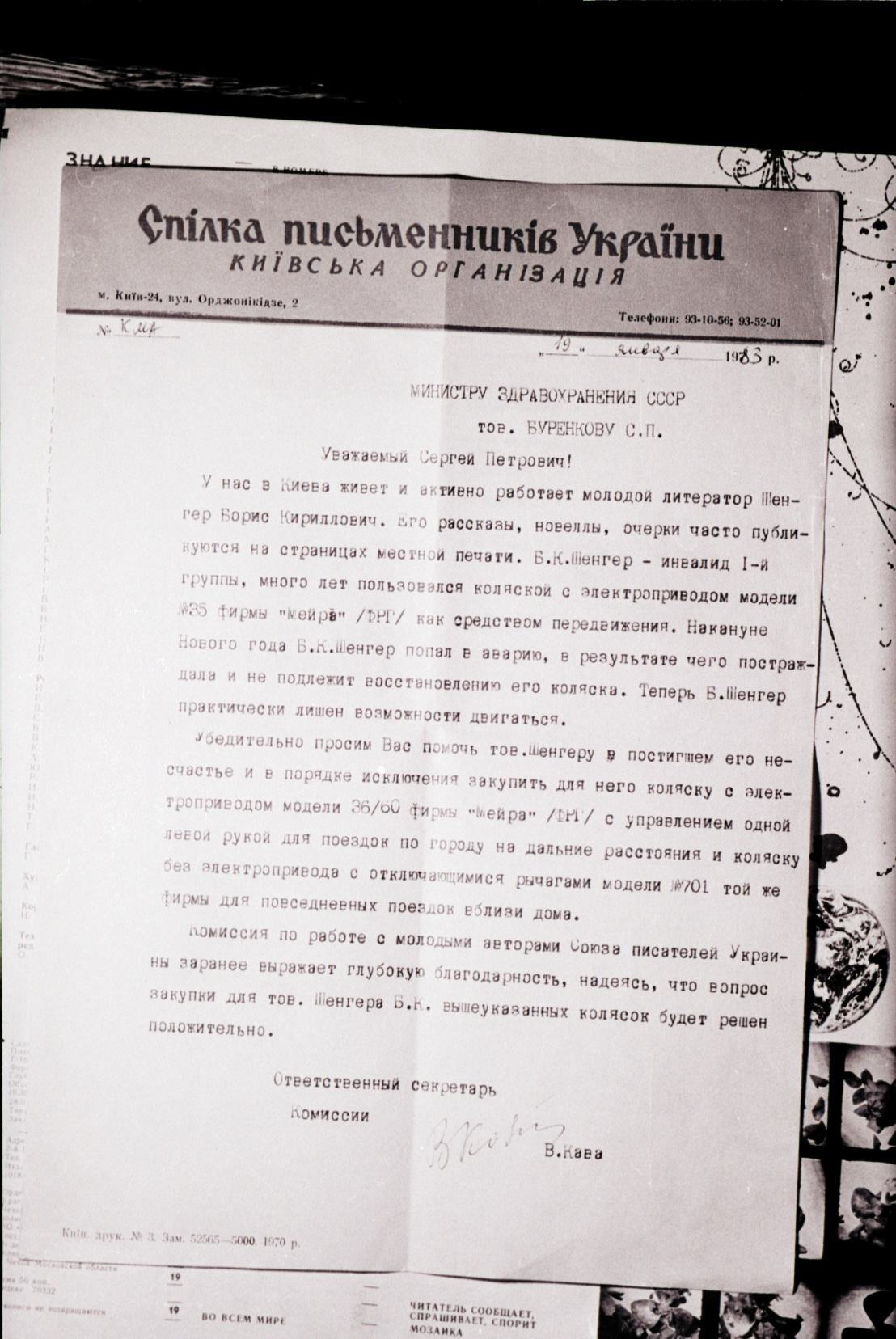
The letter describes a young writer whose stories and essays appear regularly in the local press, explains that his wheelchair was destroyed and cannot be repaired, and states plainly that he is now unable to move. It asks the minister to buy him, as an exception, a Meyra 36/60 with left-hand-only control for longer trips across the city, and a non-powered model 701 with disengaging levers for short distances near home.
Two chairs. One to reach the city, one to get out of the building.
Put the letters side by side and the same formula turns up in both: the used car in July 1982, as an exception; the two chairs in January 1983, as an exception. Two institutions, six months apart, neither aware of the other, reaching for the identical phrase.
It was not their phrase. It was the mechanism. In a documentary shot in 1988, as the censorship lifted, a man named Yuri Astakhov — disabled since the age of two, trained as an editor, never hired as one — put it plainly: a disabled person lives as an exception. You want to sit a university entrance exam? Then you go to the ministry, and to the minister personally, so that permission can be granted to you as an exception.
That is what this file documents, in one man's paperwork, five years before anyone could say it out loud on film. Shenger had no right to move. What he had was the right to petition, and to be granted movement as a favour — one machine at a time, the favour expiring the moment the machine did.
And he was good at it. That is the uncomfortable skill in these pages: not endurance exactly, but administrative stamina. Knowing which door to knock on, and which one to knock on next when the first says no. Writing to the Council of Ministers in summer, being offered a dead veteran's car instead, going to the Red Cross a month later and having them use the word reconsider. Losing the chair three days before New Year and having a letter on the desk of the Soviet Minister of Health within three weeks.
Every one of these letters is signed by somebody else. A ministry department head, a Red Cross chairman, a writers' union secretary. To get a wheelchair he needed institutions to take an interest in him personally, and he went and got them to.
He was, after all, a writer.
Twenty-six years
The roll ends there. Whether the minister replied, and what he said, is not on this film — which is not the same as saying nothing came of it. We know the campaigns sometimes worked, because he had already run one and won: the Meyra 35 wrecked on Borshchahivska Street existed at all because of an earlier round of letters like these.
We found him again in December 2008, in the Ukrainian parliamentary newspaper Holos Ukrainy (the article is still online). A reporter had met a Kyiv pensioner living on a disability pension of 1,300 hryvnia — at a time when the average wage in the country was around 1,900 — still using a German wheelchair, described as roughly thirty years old, with something over a hundred thousand kilometres on it. Driven by hand.
And that detail is the ending, if you read it carefully. A Meyra could not be bought in the Soviet Union. Foreign chairs did not turn up in shops; they turned up at the end of a paper trail like this one. So the machine he was still riding in 2008 was itself the product of a successful petition — somebody, somewhere, eventually said yes.
But it was a manual machine. Which means the 1983 letter got him half of what it asked for: the lever-driven 701 for short distances near home, and never the powered 36/60 for crossing the city. He spent the next quarter-century crossing the city on the short-distance chair. A hundred thousand kilometres is what that costs when you do it on your arms.
There was a disability-day exhibition at the Ukrainian House that December. He left home at night, crossed fourteen kilometres of Kyiv, and was there by eight in the morning. The thing he liked best on display was a powered chair from the same manufacturer as the one he was sitting in. It cost around thirty-nine thousand hryvnia — two and a half years of his entire pension, spent on nothing else.
He looked at it and went home.
In 1983 a document explained to him that the wheelchair was under his control, that this made him its driver, and that drivers are subject to the rules on lane changes. Obligations arrived promptly. The vehicle took a little longer.
After 2008, nothing. No further trace anywhere we have looked.
What the file doesn't say
It doesn't say whether the minister ever replied, or which of the two chairs arrived, or when. It doesn't say what he wrote, or where it was published, or whether a word of it survives in a Kyiv library. It doesn't even quite square with the newspaper: thirty years before 2008 puts his last chair at about 1978, earlier than anything in these pages, so either the reporter rounded or there were more machines in this story than the roll shows us.
And it doesn't say where this is.
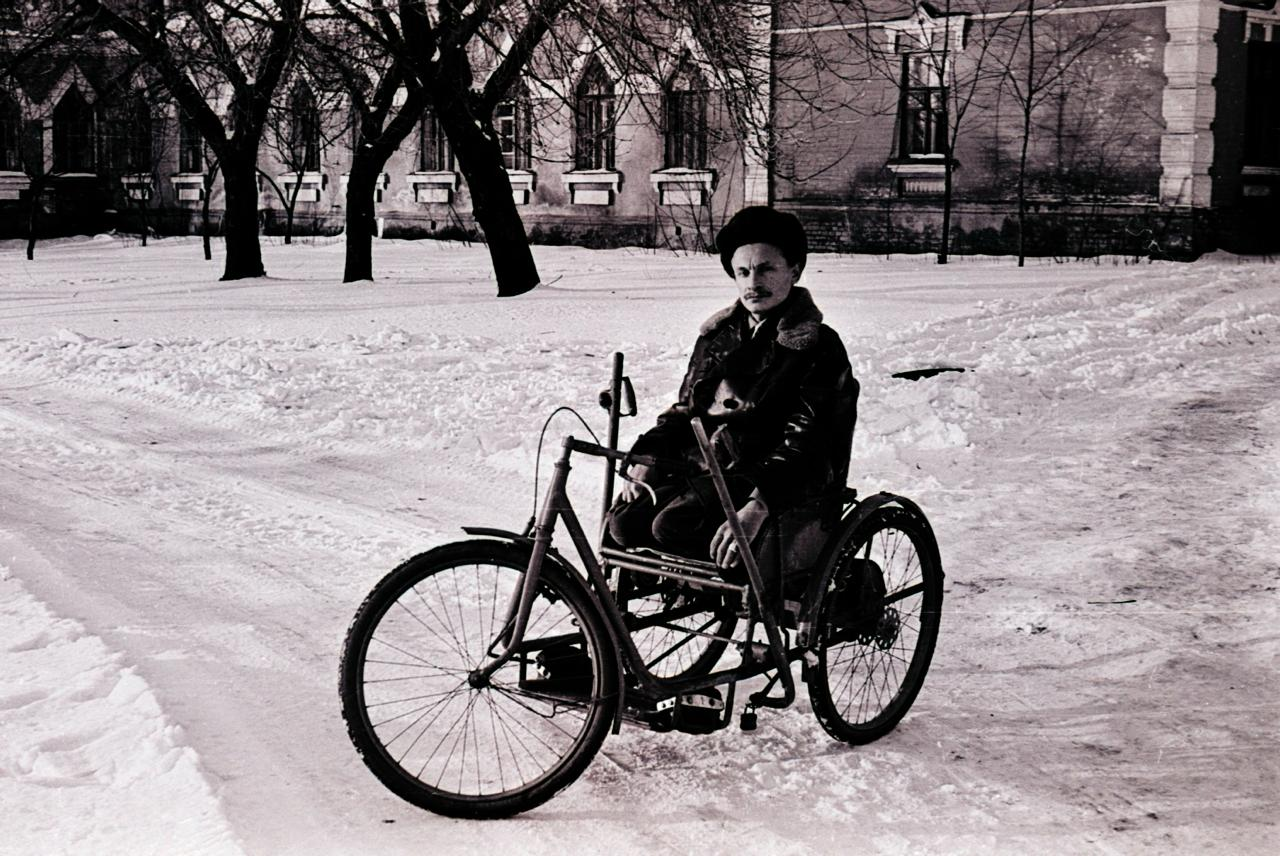
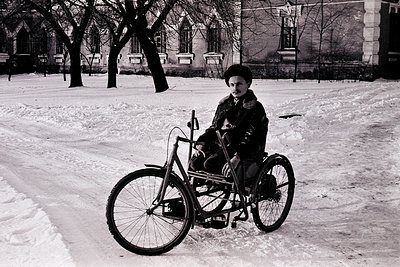
A red-brick building with pointed-arch windows, late nineteenth century by the look of it, across a yard in deep snow. A different machine — lever-driven, no motor, the kind he would still be asking for in 1983. He is younger here. And somebody took the photograph, which means somebody else was standing in the snow with him.
If the reading earlier in this piece is right, there is a fair chance this is an institution rather than a street: a sanatorium, an orthopaedic hospital, one of the boarding schools where the Soviet Union placed children whose legs had stopped working. Those were routinely housed in exactly this sort of pre-revolutionary brick. But that is a guess about a building, not a fact about a man.
We publish what we can and hold back what we shouldn't. The medical records in this file stay unpublished, and so does his address. Everything else is here.