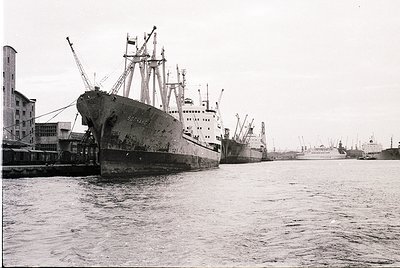
There's a rusted cargo ship in Case 16, docked at an unknown port, flanked by concrete warehouses. No date, no location, no context — just a single frame from a found roll of film. The kind of photo that could sit in the archive forever.
Except there's a name painted on the hull. And when you can read a ship's name, you can read its entire life.
Cyrillic on the bow
The lettering is Волчанск — Volchansk, in Cyrillic. That single detail eliminates most of the world's merchant fleets in one step. Cyrillic hull markings on a cargo ship of this era, with Soviet-style industrial port infrastructure in the background — this is a Soviet vessel.
And Soviet cargo ships were named systematically. They came in classes, and within a class, names often followed a pattern. If you know the pattern, a single name can unlock the whole series.
From name to vessel record
Волчанск is a small city in Sverdlovsk Oblast, in the Urals. That alone is a useful signal — Soviet ships were frequently named after cities. But the real breakthrough comes from cross-referencing the name against ship registries.
FleetPhoto.ru, a Russian vessel database, has the complete record. The ship named Волчанск was yard number 456, built at VEB Warnowwerft in Warnemünde, East Germany. Completed 18 October 1968. Home port: Vladivostok.
She was a Project 431, known as the "Vyborg type" — a class of 31 general cargo vessels designed by the Warnowwerft shipyard's own engineering bureau and built between 1962 and 1969. Eighteen of them went to the Soviet merchant fleet, and those were all named after Russian cities starting with the letter В: Выборг, Вятка, Вязьма, Великие Луки, Волжск, Волхов, and so on. A Soviet-era phonebook of mid-sized cities, bolted to 150 meters of East German steel.
What the record tells us about the photo
The Волчанск served under that name from 1968 until December 16, 1990, when she was sold to North Korea and renamed Jong Pyong, with her home port changed to Nampo. She was eventually scrapped in Chittagong, Bangladesh, in 1992.
That gives us a hard date window for the photograph: 1968 to 1990. Before 1968, the ship didn't exist. After late 1990, it carried a different name.
The ship's home port was Vladivostok, which means she operated primarily in the Pacific — but Project 431 vessels had an unlimited sailing range (13,200 nautical miles) and regularly carried cargo to ports across the world. Vladivostok as home port doesn't pin down where this photo was taken. It just tells us where the ship was registered.
The specs, for the ship-minded
Project 431 vessels were workhorses: 150.7 meters long, 20 meters wide, deadweight tonnage of 12,295 tons. Powered by a single MAN diesel engine built in Rostock, making 8,150 horsepower — service speed around 16 knots, topping out at 17. Five cargo holds, twelve 5-ton derricks, and one heavy-lift boom rated for 60 tons. Crew of fifty.
If you look at the photo and see the derricks along the deck - that profile matches. It's not proof on its own, but the silhouette is consistent with the class.
What's still open
We know the ship. We know the class. We know the date range. What we don't know is where this photo was taken.
The concrete warehouse structures in the background have a distinctly mid-century modernist industrial style. The water appears calm — possibly a harbor or a sheltered bay. The overcast sky and the overall tone don't scream tropical, but that's a soft signal at best.
Here's what makes this case especially interesting: the same film roll includes several frames of a rocky coastline with rough waves and jagged rocks, and what appears to be someone diving into the sea from those rocks. Were these taken near the same port? If so, the coastal geology becomes a second identification vector — volcanic rock formations, wave patterns, and shoreline type are all geographically constrained.
Where you come in
The port is the puzzle now. The architecture, the waterfront infrastructure, the coastline on the adjacent frames — any of these could crack it.
If you know Soviet-era port architecture, or you recognize that style of concrete warehouse, or the coastline in the other frames looks like somewhere you've been — Case 16 is open and waiting.